
Veni, Vidi, Barbi
Cinema is back, baby!

Hello all, it’s been a minute, and good grief has a lot happened. I was going to talk about any number of important issues, but thought, instead, we might just have some good old fashioned fun. We deserve it.
Minor Majors:
Trump’s in trouble again, and this time he has lawyers with real-people names, and not cartoon mafiosos, so… must be serious.
I’ve heard rumblings of a new Mitski album on the horizon. Between this, Good Omens, Heartstopper, Our Flag Means Death season two in October, sad gay people have so much to rejoice over. I feel like this should warrant PTO.
Mark Zuckerberg and Elon Musk are beefing in the funniest way imaginable. Every time I receive information about this, I immediately assume I’m reading an Onion article and continue to be resoundingly proven wrong at every turn. This really couldn’t be better, I mean, we can kick back and relax, I think the rich are eating each other.
Someone requested that we bring back the Word of the Week. I am nothing if not a benevolent blogger so, Word of the Week is actually two words: Folding Chair.
Current Events:
Out of respect for the continued SAG-AFTRA and WGA strikes, I thought perhaps I wouldn’t discuss struck movies, but, as the unions have made it clear that critics can go ham, I thought that, in their honor, we’ll do reviews, but we’ll be needlessly overcritical. And, to be so honest with you, I’ve been bursting at the seams waiting to talk about this summer’s lineup, well really, waiting to talk about two movies in particular. Welcome to the Silver Screen Special.
Red, White, & Royal Blue
Folks, I’m not exaggerating when I say that this movie has occupied more mental space in the past few days than anything else going on in my life. And, as the days since my initial viewing stretch, I find myself only more consumed. This movie has taken years off my life. This is my favorite movie of the year. This movie makes no sense. I want to mainline this movie straight into my bloodstream.
Red, White, & Royal Blue follows Alex, the son of the US president, and Henry, England’s prince, as they fall in love in the wake of a diplomatic incident involving cake and a royal wedding.
This movie has everything. Surreal editing, Rachel Maddow, pacing so fast it might induce a cardiac incident, somehow both more and less sex scenes than feel tonally appropriate, Stephen Fry in an ill-fitting suit as the King of England looking straight down the barrel of the camera to deliver a mildly homophobic rant about spies in the second world war, Uma Thurman playing a Texan US President delivering a soliloquy about safe practices regarding anal sex, the line: as gay as the first 50 rows of a Gaga concert spoken about a member of the royal family, a leaked email scandal tangentially related to a high ranking female politician… the list goes on.
Though words cannot truly describe the feeling of watching this movie, Rachel Handler’s analysis in Vulture comes as close as it gets:
This movie definitely exists within an unholy Venn diagram alongside the Netflix Christmas Universe, which you and I are intimately familiar with and which has claimed its rightful place as perfect lobotomy cinema. I would argue that the performances in RW&RB [] feel more “Disney Channel Original Gay Porn” than anything else.
But, it’s so much more than that. Of particular import is Uma Thurman’s baffling portrayal of a Texan president, done with the level of accent-related enthusiasm and naked glee of Robert Pattinson in The Devil All The Time, or of Robert Pattinson in The King, or of Robert Pattinson in The Lighthouse, but with the level of accent-related success of Kevin Costner in Robin Hood: Prince of Thieves, or of Kevin Costner in Thirteen Days, or of Kevin Costner in The Company Men. And she uses it to deliver a Truvada ad live from the oval office.
And then there’s the editing. Granted— the film has some hurdles to overcome, namely fitting an involved book plot (perhaps I forgot to mention this is an adaptation of a novel of the same name) into a 2 hour film, (more on that in a second), as well as the fact that a good portion of the romance takes place via texts, emails and phone calls, all notoriously tricky to capture in a visual storytelling format. A valiant effort is made to keep those engaging— and actually, some of the choices there really work, but between bouts of clever use of the medium, are these jarring, tonally flummoxing sex scenes filled with cross cuts and random insert shots that then immediately transition back into Hallmark territory without so much as a second for the viewer to breathe.
And, as I mentioned before, in light of it being an adaptation, news has leaked that the movie was initially a staggering three hours long before significant cuts were made, leaving gay cinephiles everywhere to demand Jeff Bezos release the Red, White, & Royal Blue Snyder cut, and to that, I must concur. I’d delete Oppenheimer from existence for even ten more minutes of the unbridled joy and deep, hysterical bewilderment of Red, White, & Royal Blue.
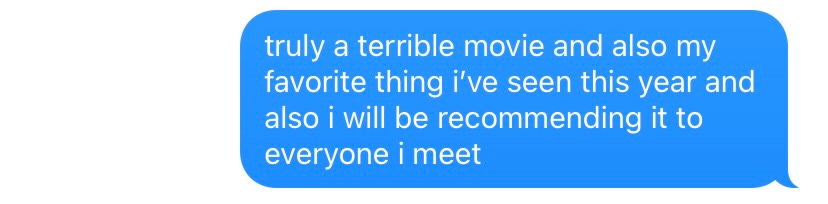
To best sum up my feelings on the matter, this was my first reaction upon viewing this surrealist masterpiece:
Heart of the Issue:
This Barbie is Deeply Confused
In all honesty, I had expected to come racing into this section with strong opinions. Given the press surrounding Barbie, including but not limited to Ben Shapiro’s feverish meltdown regarding its subversive feminism, and the strong reactions from women claiming it was the first film that made them feel seen, I sat down ready to watch a highly controversial quasi-adaptation of The Feminine Mystique, self-critical of its capitalist background and of Barbie’s role in the storied history of American womanhood.
Barbie was not that.
Barbie was certainly entertaining, funny, and visually lush, with standout performances from Ryan Gosling, America Ferrera, and Kate McKinnon, and the standard Gerwig fare— thoughtful portrayals of the complicated interpersonal relationships between women.
Fundamentally, it was an enjoyable movie.
But, I suppose, similar to my reservations about Gerwig’s Little Women, Barbie spends so much time telling us it’s a feminist movie that it forgets to be a feminist movie. The film browbeats its self-aware, painfully ironic, (dare I say Marvel-esque?) slightly cynical and unimaginative take on womanhood from the very opening, sarcastically quipping that “thanks to Barbie, all the problems of feminism in the world have been solved.”
We are introduced to Barbieland, a sort of parallel universe in which the Barbies hold all positions of power and the Kens exist mainly as second class citizens subservient to the Barbies. This is meant to be seen as the opposite of the real world, because of patriarchy I suppose. We are introduced to Gosling’s Ken, whose main goal it seems is to make Barbie notice and prioritize him.
The catalyst for the story is an entertaining one— Barbie starts to become more self aware, wondering about death and about her place in the world. Cue an adventure to the real world, the discovery that women’s issues still exist, and the breakdown of Barbieland’s seemingly utopian society.
The resulting narrative threads are either ideologically confused or purposefully ideologically confusing, depending on how much you view this movie as a very effective Mattel ad.
When Barbieland is inevitably conquered by patriarchy, it is a laid-back, toothless, and bloodless affair. Simply by hearing about patriarchy, the world bends to it, and thusly there are no real deliberate actors and no real agency. In this way, Barbie’s patriarchy is blameless, the Kens are not antagonistic, as they are just as helpless to this patriarchal phenomenon as the Barbies are.
And, most confusingly, the film seems to hint at the idea that if anyone is to blame, it’s Barbie herself, who is repeatedly chastised for her role in women’s beauty standards, (which are, in the film, treated often as the sole facets of modern-day sexism and women’s subjugation.)
Inside of the film, I found there were about five other more interesting movies. Michael Cera’s Alan, repeatedly shown as being more comfortable around the Barbies than the Kens, struggling to find a place for himself in either the matriarchal or patriarchal versions of Barbieland, was a standout for me as a character whose story could have lent this film the nuance it was so desperately lacking.
Reviews in certain spaces reflected my own gripes with the film’s take on women’s issues. From Marya E. Gates on Letterboxd:
Works when it’s just a fun, weird, popcorn Summer adventure film. But, [] falters when it tries to be an Important Movie.
There’s a debate on whether it is a “feminist” movie from those who made it and those who’ve reviewed it and what I’ll say on that is that it does the bare minimum when it comes to “feminism” [] and “representation matters” style inclusivity, while thinking it’s being insightful and transgressive (it’s neither.) There’s a speech one character gives that a) feels outdated by twenty years or more, b) is deeply non-intersectional in its viewpoint of “womanhood” and c) is delivered in that very loud yelling style to broadcast that this is Important and Profound.
Or, more succinctly, from user Lefty on Letterboxd:
Great movie for people who JUST realized that women deserve rights too!
That all being said, the film has its myriad defenders, many of whom argue that Barbie cannot be at once a deeply nuanced take on feminist theory of the past 50 years and also be an accessible blockbuster hit. And, I can accept that as a valid take. If this movie spoke to people, it spoke to people.
And then, there’s the vitriolic reaction the film has gotten from far-right, anti-feminist circles, prompting the rest of us with souls to try and swing back in the movie’s defense.
I think two different debates are going on here. One asks if this movie’s thesis is as cogent a feminist argument as it wants you to believe. The other asks if films about women should exist at all. For those of us caught in the crossfire, it becomes difficult to lodge criticism for fear of being seen as anti-woman in some way. Or, as Gen Z would call it: not being a girls’ girl.
And it seems we’ve come around full circle to the brand of feminism I’ve long been critical of, whether we’re still calling it 5G wave feminism, or girlboss feminism, choice feminism, pop feminism, t-shirt feminism, all of which describe the capitalist, white, womanhood-is-feminism ideology that hoists “girls supporting girls” over critical engagement with media and society.
For me, that is about as scathing a review as reviews can be, that this film is Taylor Swift-ing us.
But, I think that’s a little dramatic. This film is not of its own propagandizing powers Taylor Swift-ing us. We are mostly Taylor Swift-ing each other. We’ve got to stop forcing the consuming of media to be an act of self-representation. Seriously guys, cut it out!
We need to get more comfortable with the simultaneous enjoyment of and critical engagement with media. We cannot rely on the easiest answers, we need to escape the mindset that our favorite movies should say something about us.
That brings me back to Barbie’s place in the world as an advertisement campaign. It’s asking of “which Barbie are you?” and extensive merchandising and constant on-screen catalogue of Barbie products are what make it fundamentally incapable of being a genuine feminist work.
Barbie was never going to be the updated Feminine Mystique. Barbie was never going to be revolutionary. We’ve dragged a plastic toy into the culture war. We look silly doing it.
I guess all that’s left to say is this:
I give Barbie about 3 out of 5 stars.
With that, as always, thank you all for reading, and be well.